
The Evidence Engine
Evidence discovery built around the whole case.
A complex presentation deserves more than a single search. SYMALA searches across conditions and primary symptoms, broadens discovery through a tiered ladder, and ranks literature for clinical usefulness.
Precision
Prioritise papers that inform clinical decisions for this case.
Breadth
Search across conditions and primary symptoms to cover the whole case.
Inspectability
Review the sources, rationale and evidence gaps.
01 / Clinical context and Evidence Focus
AI prepares the context.
You confirm the direction.
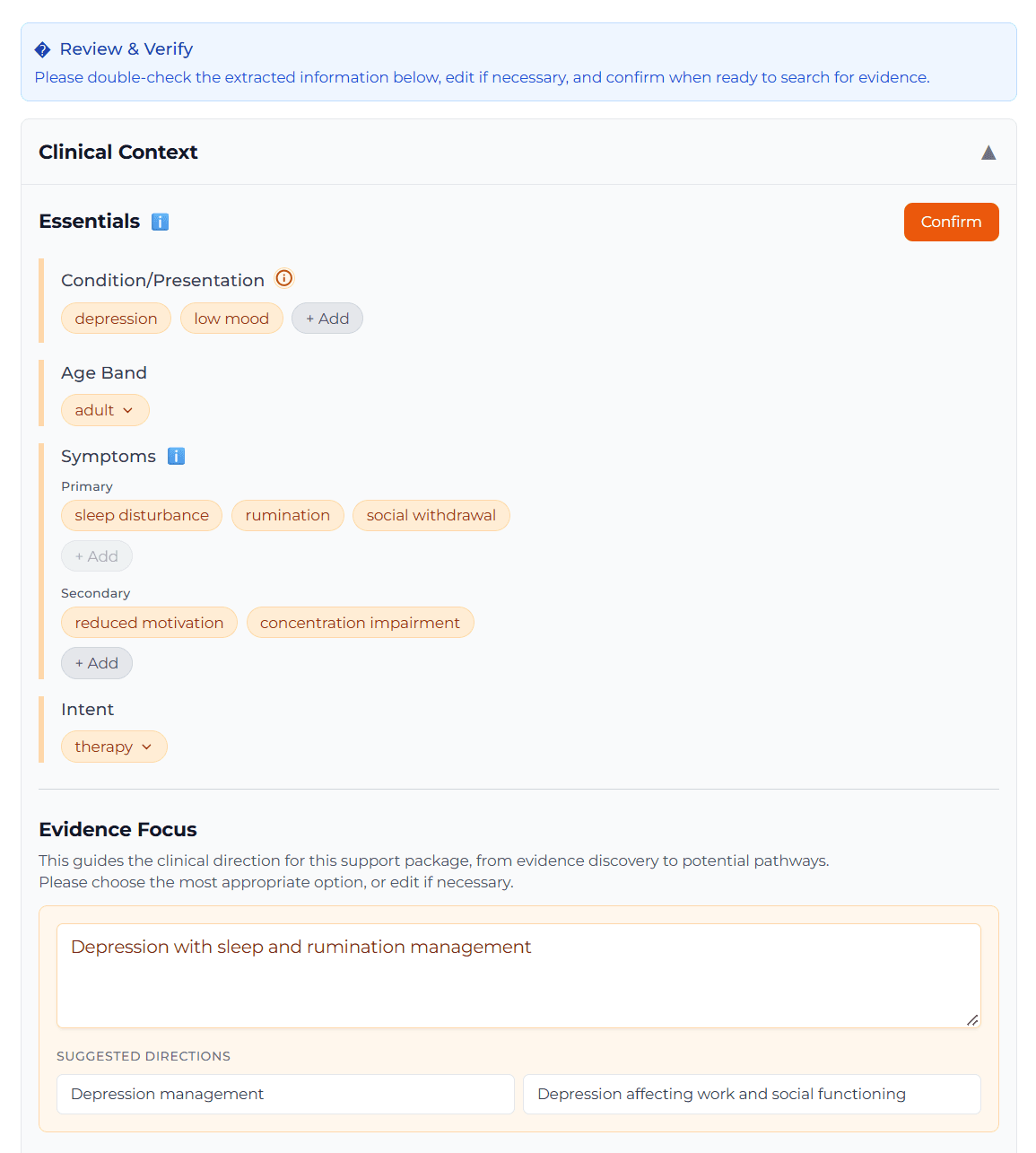
SYMALA extracts clinical context from your case notes and suggests an Evidence Focus. Before evidence discovery begins, you review, edit and confirm both.
Confirm the case
Check the conditions, age band, primary and secondary symptoms, and clinical intent. Correct the extracted context so the search starts from your understanding of the case.
Set the Evidence Focus
Choose or write the clinical direction that matters now. Your confirmed focus guides evidence selection, the support package and potential pathways.
Unchecked assumptions can send a clinical workflow in the wrong direction. SYMALA keeps this decision with the clinician, rather than letting AI approve its own interpretation.
02 / Coverage across the case
Give each clinical combination a place in the search.
The engine creates separate searches for each condition × selected primary-symptom combination. It uses original and enriched terminology to support focused matches and broader discovery.
Coverage is tracked as candidates are narrowed, helping reduce the chance that one well-covered topic dominates the case.
34 year old male presenting with depression over the past two years: low mood most days, poor sleep, withdrawal from friends, low motivation and concentration at work, and frequent rumination. Previously had a course of counselling with partial benefit. Goals are to lift mood, reconnect socially, and function better at work.
| Condition | Sleep disturbanceSleep disturbance | RuminationRumination | Social withdrawalSocial withdrawal |
|---|---|---|---|
| Depression | Illustrative journal article discovery for Depression and Sleep disturbance. No actual result count is represented. | Illustrative journal article discovery for Depression and Rumination. No actual result count is represented. | Illustrative journal article discovery for Depression and Social withdrawal. No actual result count is represented. |
| Low mood | Illustrative journal article discovery for Low mood and Sleep disturbance. No actual result count is represented. | Illustrative journal article discovery for Low mood and Rumination. No actual result count is represented. | Illustrative journal article discovery for Low mood and Social withdrawal. No actual result count is represented. |
03 / A tiered discovery ladder
Start focused.
Broaden with purpose.
Applicable stages progressively broaden retrieval, creating room for useful literature beyond the closest initial matches.
This is a discovery ladder: moving down it broadens the search, rather than automatically lowering the quality of the studies. Some stages may be skipped, depending on the case and search configuration.
- 01
Gold
Prioritises study types suited to the clinical focus
- 02
Tight
Seeks the closest clinical match
- 03
Balanced
Looks for relevant evidence in the patient population
- 04
Broad
Expands into wider clinical context
- 05
Wide
Provides broader supporting discovery when needed
Engine in action
See discovery become a focused evidence base.
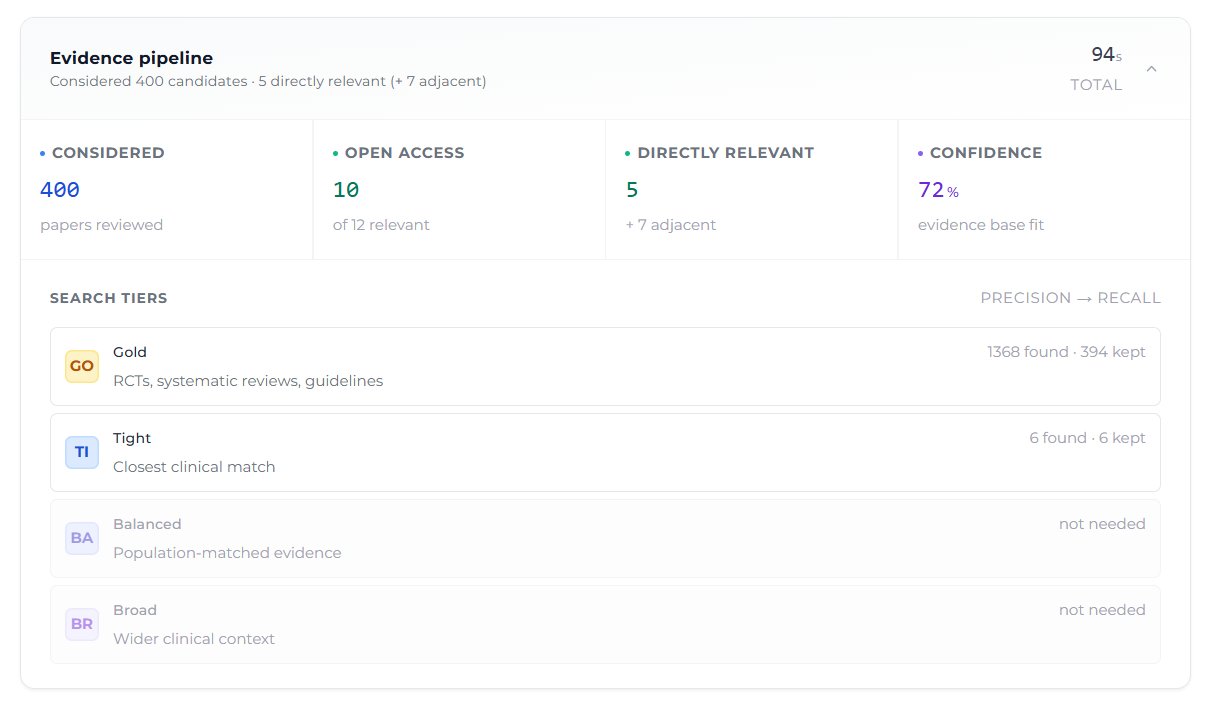
The pipeline makes its progress visible: candidates considered, relevant papers, open access and the discovery tiers used for the case.
04 / Clinical usefulness
A retrieved paper is a candidate.
Its relevance still has to earn its place.
Matching keywords is only the start. Ranking considers your Evidence Focus alongside clinical applicability, patient population, scope of practice, study quality, safety relevance and practical usefulness for the current decision.
Direct
Addresses the condition and primary clinical problem, with a concrete clinical takeaway.
Adjacent
Related evidence that may help fill a meaningful gap, with a less direct fit.
Background
Context that helps interpret the case, kept separate from evidence used for subsequent synthesis.
Why this paper matters
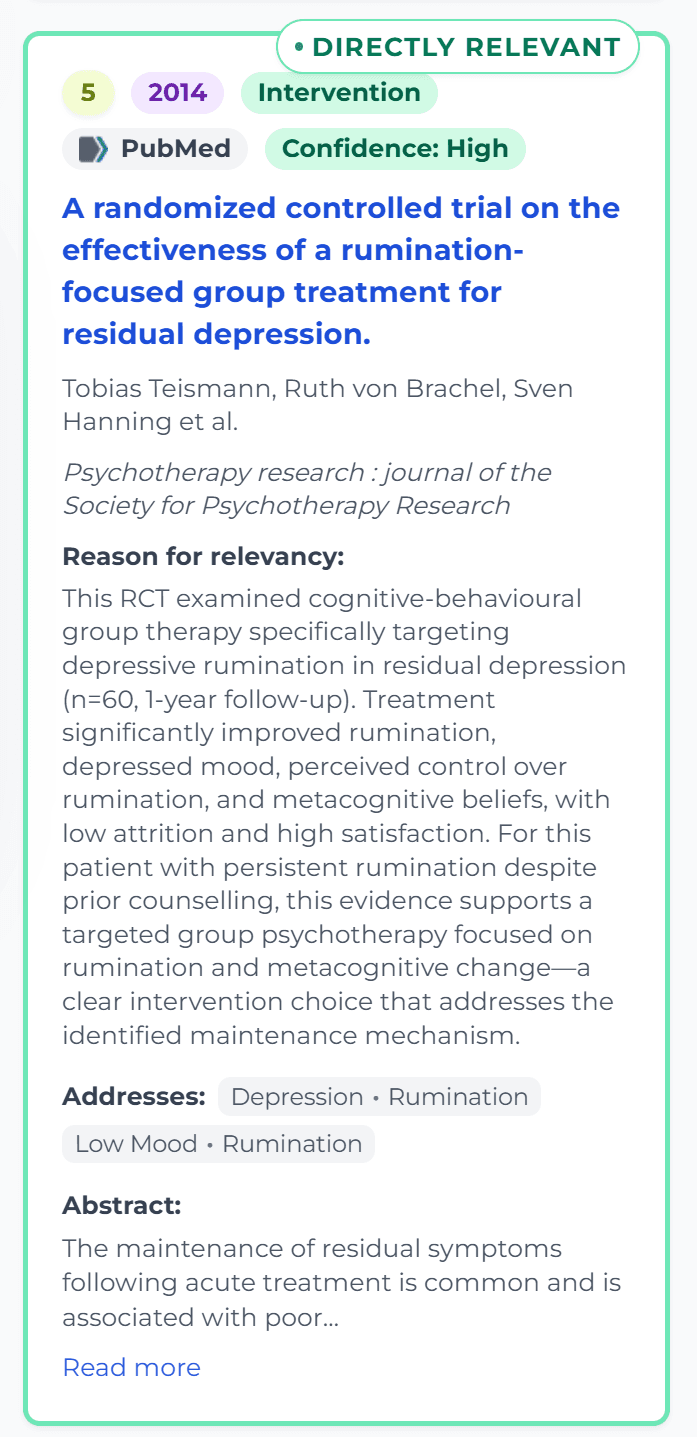
“Relevant to this adult’s depression and persistent rumination. The study examines a rumination-focused group approach, helping assess its fit for the case’s depression management focus.”
Every ranked paper includes a case-specific rationale explaining why it matters.
05 / Evidence you can inspect
Follow the sources.
See the fit. Notice the gaps.
Evidence quality and gaps
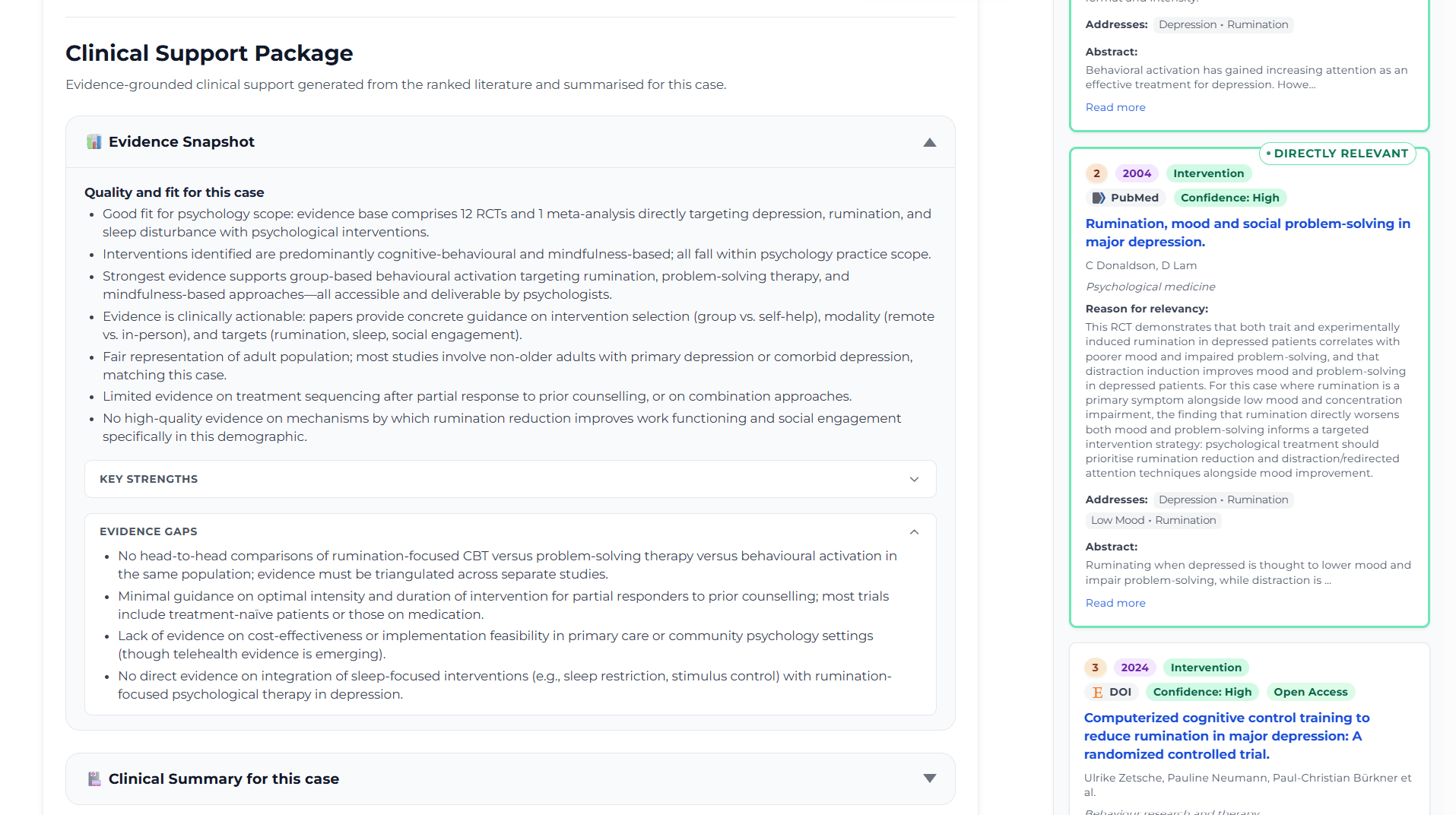
The evidence snapshot summarises how well the research fits the case, highlights its strengths, and makes gaps visible alongside the ranked papers.
Why each paper matters
Every ranked paper includes a case-specific rationale, relevance category and the clinical combinations it addresses, alongside publication details and its abstract.
For clinical evaluators
What to understand before you evaluate.
Does the engine find everything?
No literature search can guarantee complete coverage. SYMALA searches across the selected conditions and primary symptoms, expands discovery through applicable stages, and tracks coverage as candidates are narrowed. Results still depend on the case inputs, indexing, available literature and enabled sources. A search match does not establish clinical relevance.
Does the highest study design always rank first?
No. Study quality matters alongside clinical applicability, patient population, scope of practice and usefulness for the decision at hand. A stronger study design does not automatically make a paper the best fit for a particular case.
Is every paper read in full?
No. Initial ranking uses retrieved titles, abstracts and case context. Full text is then sought for selected relevant papers where accessible. When full text is unavailable or cannot be retrieved, the available abstract is used. Background papers provide context and are kept separate from the evidence inputs used for subsequent synthesis.
What do confidence labels mean?
They are the engine’s assessments of its paper categorisation and scoring, or of the overall evidence base. They are not validated accuracy measures, probabilities of treatment success, or a substitute for clinical appraisal.
What happens when useful evidence is scarce?
The engine can attempt to refine discovery when no candidates or no useful ranked papers are found. The evidence snapshot surfaces strengths and gaps when available. A limited or empty shortlist can be a valid result; it does not establish that no relevant evidence exists anywhere.
Does SYMALA force guidance when evidence is missing?
No. SYMALA builds support from the evidence discovered and ranked for the case. When supporting evidence is missing, it is designed to leave the gap visible or mark the detail as not reported, rather than force a recommendation or fill the space with generic AI advice. Knowing where the evidence stops is part of informed clinical judgement.
From case notes to care planning.
Evidence at every step.
See how case context, ranked evidence, goals and pathways stay connected in SYMALA’s structured allied health workspace.